
Who’s Responsible For Wildfire?
It’s time to stop thinking of wildfire only in terms of ignition source

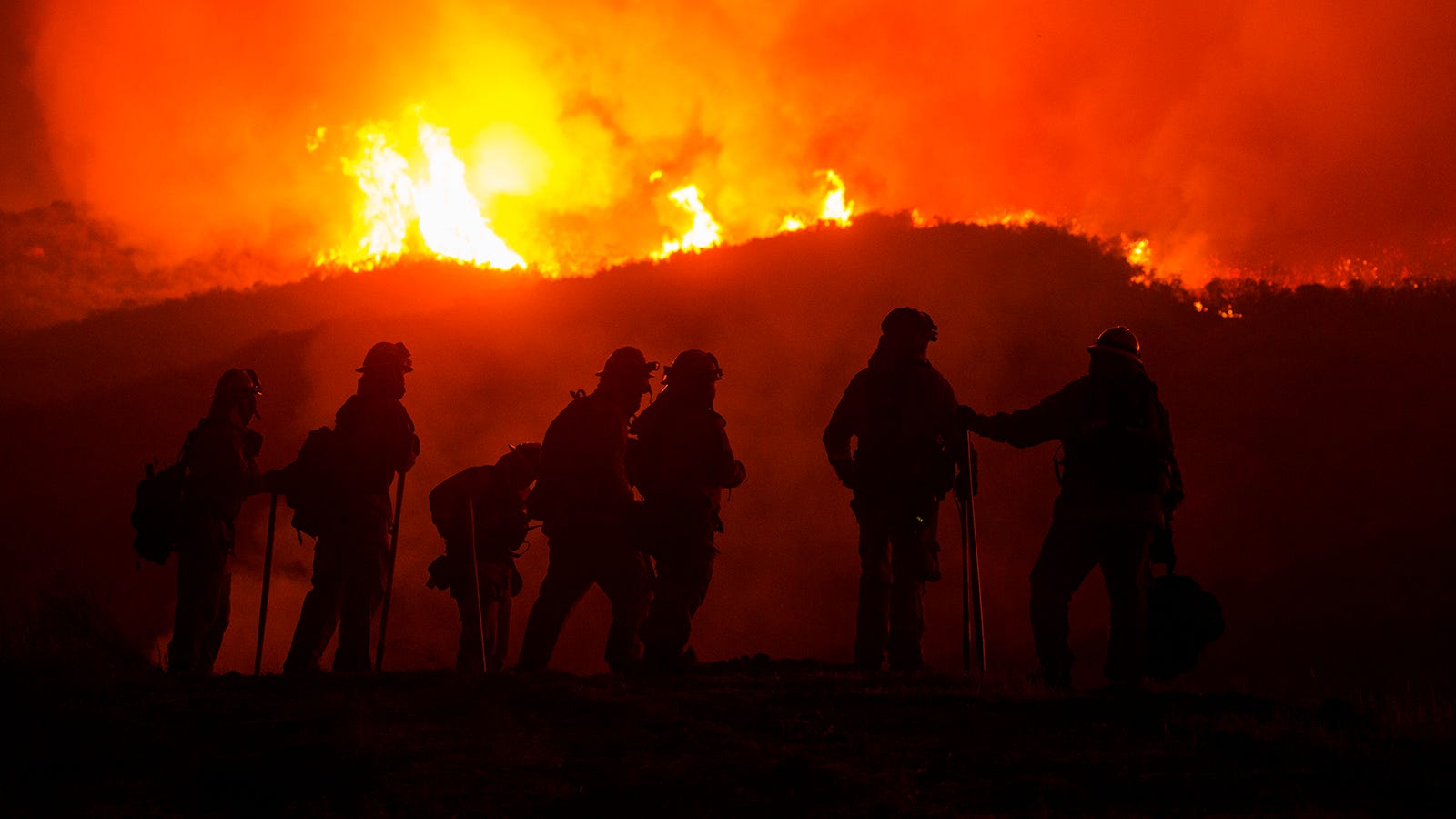
Two big pieces of news around the sources of wildfire this week: a man has been arrested and charged with arson for allegedly starting one of the three major wildfires that tore through Spokane over the weekend. And, an investigation by the LA County Fire Department has concluded that electrical arcing on an out-of-service SoCal Edison electrical tower is responsible for starting last year’s Eaton Fire, which damaged or destroyed 9,000 homes and killed 19 people in Altadena. While it might be easy to point fingers at the people or corporations who technically ignite a fire, they’re far from the only responsible parties.
I had just this discussion over the weekend with one of my wife’s cousins, as news of the fires in Spokane started to roll in. His dad had gotten an evacuation order, and we were trying to figure out how at-risk he and his home were. While I pulled up fire maps, satellite heat tracks, and wind direction, he made a remark that the fire was probably set by some meth head.
And while it looks like Lance was right, that’s not the takeaway I see here. The real blame lies with the factors and players that created the kind of conditions where some meth head could spark a fire that would grow fast and large enough to destroy over 1,000 total structures in Washington’s second largest city. Let’s identify those and talk about them.
It’s Climate Change
The easiest-to-identify and most obvious culprit here is simply our warming planet. There was little to no snow out West this winter, which was followed by a wet spring and now a dry, hot summer. All of that means rivers and streams are low, there’s tons of new brush and grass growth, and that’s all dried out now, just ready to turn any spark that hits it into flames.
On a warmer planet, fires start more easily in more areas, and grow faster.
But the biggest problem with climate change is that it’s not happening in a vacuum, it’s happening with and to human systems that exacerbate its risk. And because of those human systems too, of course. We’re accelerating the pace of climate change, even while utterly failing to adapt to its risks.
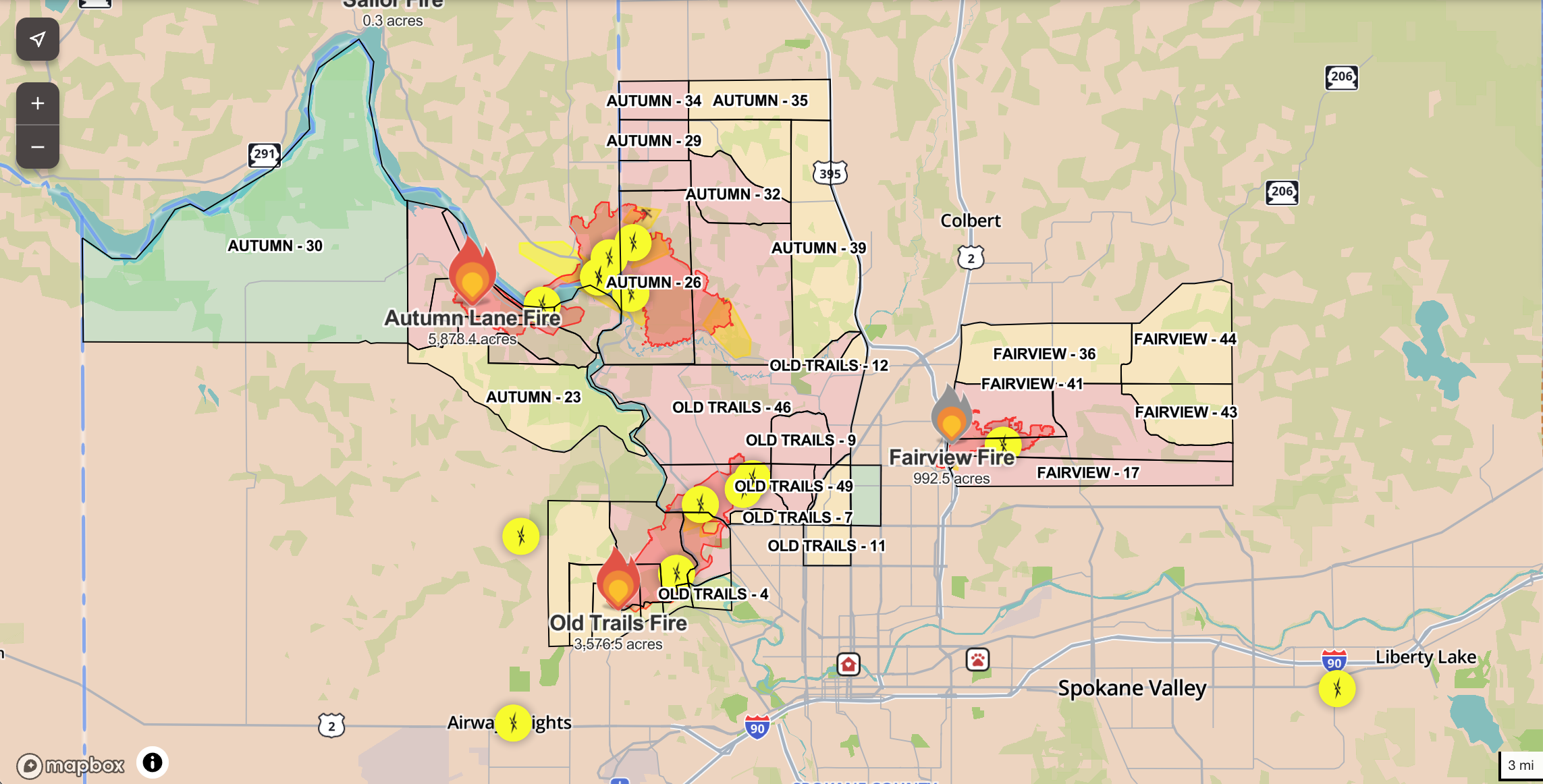
Image: Watchduty
It’s Where We Build
Above is a map of the areas of Spokane burned this weekend. Below is a map of the area’s wildland-urban interface.
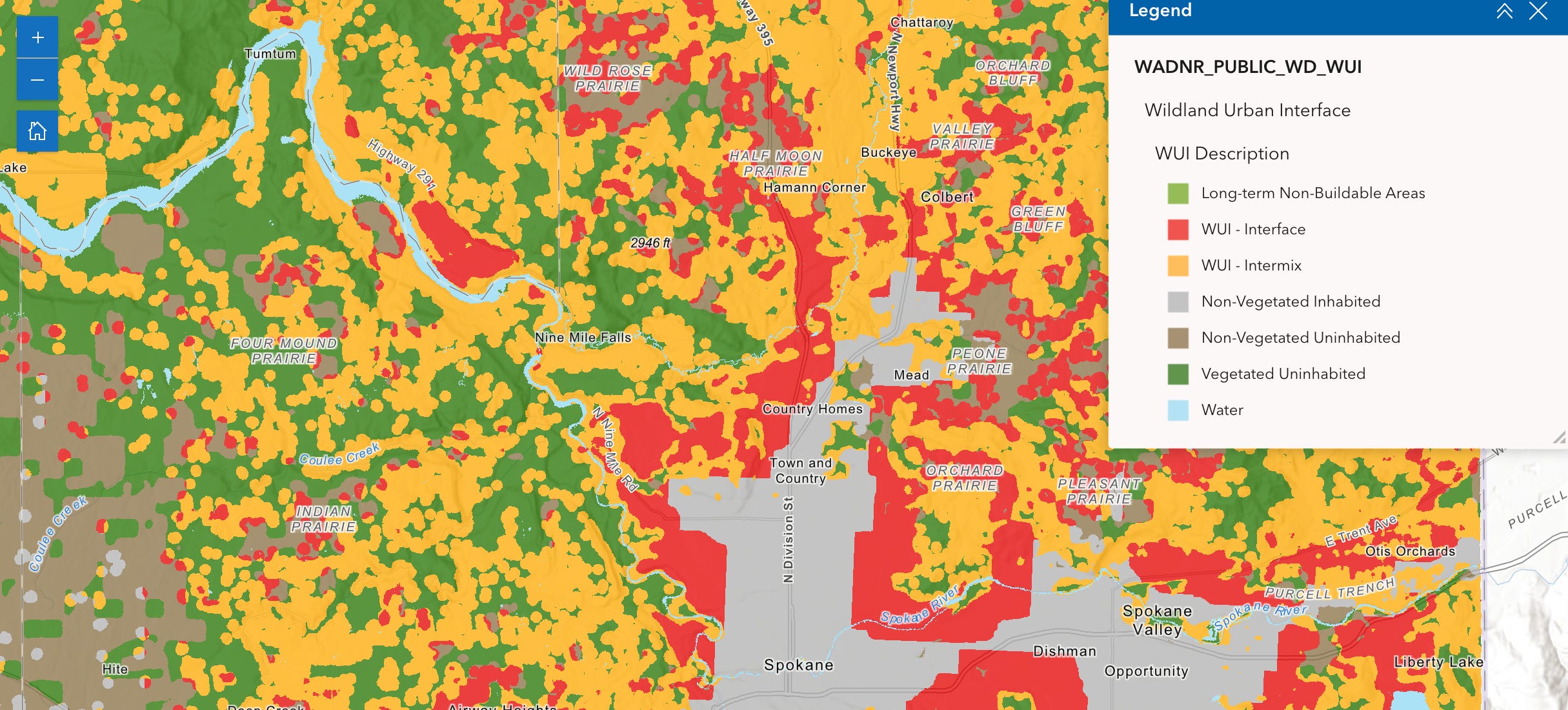
Image: Washington Department of Natural Resources
“The wildland–urban interface (WUI) is the area where houses meet or intermingle with undeveloped wildland vegetation,” explains the Forest and Wildlife Ecology Lab at the University of Wisconsin-Madison. “The WUI is thus a focal area for human–environment conflicts, such as the destruction of homes by wildfires.”
Nationwide, over 44 million homes have been built in the WUI. As those areas become hotter, fires will start in places that haven’t had them before, those fires will start easier, and grow faster.
It’s How We Build
With Spokane’s Old Trails fire, what started as wildfire quickly became wind-driven structure-to-structure fire. Why? Two reasons: Climate change shifts weather patterns, makes extreme weather more likely, and amplifies extreme wind events. And, the building codes we use in America focus on containment of and escape from structural fires, not resisting wind-driven ember storms.
In the US, the International Wildland-Urban Interface Code is adopted voluntarily by individual counties, states and municipalities. For example, Spokane County does not enforce mandatory IWUIC compliance, while the City of Spokane does.
This was a known vulnerability in Spokane. And the problem with non-mandatory or insufficient building codes is that while you can bring your home in compliance voluntarily, you’ll still be at risk if your neighbors allow their house to turn into an inferno.
Mitigating the risk of wind-driven embers involves removing flammable materials and brush from the area surrounding your house, building it from materials that resist both heat and combustion, sealing up potential ingress points for embers using vent mesh, and eliminating points of vulnerability like plastic water meter boxes and flammable deck items.
But this is a community-level intervention, not an individual one, sort of like a vaccine. Adequate building codes reduce individual risk substantially, shielding the community as a whole, but only work if everyone participates.
The Old Trails fire, for instance, began in Spokane County before spreading into the city.
It’s How We Manage Forests
Most ecosystems in North America evolved to burn. But we’ve employed a strategy of total fire suppression for more than a century. This has choked our forests with timber that’s grown too-dense, and as climate-caused factors like bark beetles have killed off millions of trees, also with too-dense deadfall that ignites easily and burns hotter than grasses and brush, exacerbating the risk and incidence of devastating fires.
As forestry science has evolved, we’ve learned that controlling rather than preventing fires is the better solution. But as we’ve built so much real estate inventory in fire-prone areas, we’ve been prevented from adopting a more natural approach to forest management. People that build houses in pretty places don’t like to be inundated with smoke from controlled burns, and the various governments and agencies responsible must carefully consider the risk conducting burns poses to homeowners.
The result is a textbook Catch 22 situation: The area we need to burn increases every year, even as the area we can burn each year decreases.
It’s Fascism
Fascism is a system in which the government works in benefit of those in power, rather than the people. Fascists take and hold power by lying.
It’s become common to see this administration talk of the need for “forest management”. And while that’s true, as identified above, what they’re actually talking about is expanding logging operations. And because logging leaves behind brush and saplings that burn more easily than mature trees, while causing a boom in grass and brush growth afterwards, it doesn’t actually reduce the incidence or severity of wildfires, unless it’s performed immediately adjacent to homes.
Hoping to pass the buck to future administrations (assuming we get such), Secretary of the Interior Doug Burgum, who’s responsible for the new inter-department Wildland Fire Service, has ordered a policy of “full suppression” of all wildfires. Not only is that working flawlessly, as we’ve already seen (5.4 million acres have already burned in wildfires this year), but it’s being used as a vehicle for corruption and self-dealing rather than public service.
Remember that Montana Senator who broke the arm of a uniformed Marine veteran for exercising his first amendment rights earlier this year? That’s Tim Sheehy, who founded a company called Bridger Aerospace.
Attempting to immediately extinguish any fire that starts, even in remote areas of the Mountain West, as Burgum has ordered, inherently involves fighting those fires from the air. It just so happens that Bridger Aerospace is the largest contractor equipped to do that.
Earlier this year, Burgum delivered to his colleague in the Senate a $30 million contract just to keep Bridger’s four Super Scooper aircraft fueled and ready to go for the rest of fire season. On top of that, they’re billing taxpayers $20,000 per-hour of flight time. The total annual budget for the new Wildland Fire Service is only $3 billion annually.
And Sheehy is putting that money to good use. According to reporting by Re:Public, the Montana Senator proposed a law that would reduce inspections of private firefighting aircraft after Forest Service inspectors found a crack in one of his plane’s wings that, “could have proved catastrophic.” That same legislation would expand federal reliance on Bridger’s fleet.
Since 2021, USFS has paid Bridger more than $235 million. Re:Public reports that Sheehy owns “between $13 million and $15 million” in the company’s stock.
At the same time as taxpayers are enriching the Senator who writes wildfire legislation, we’re apparently no longer funding meaningful use of controlled burns.
“Between CY2021 and CY2024, the Forest Service completed hazardous fuels projects on an average of about 3.6 million acres of USFS managed land per year,” reads a report by Grassroots Wildland Firefighters. “In the first nine months of CY2025, less than 1.7 million acres were treated.”
That reduction in area treated by controlled burns varies heavily by state. In Idaho, where 243,000 acres have already burned this year, USFS only completed 21 percent of its targeted area for controlled burns last year.
And there is, of course, the matter of the 3,400 USFS employees RIF’d by DOGE last spring. While Secretary of Agriculture Brooke Rollins has lied and said that didn’t reduce preparedness, hundreds of those were “red card holders” or staff trained to support firefighting operations.
Who’s Responsible For Wildfire?
Go ahead and lock up that guy in Washington, and write Edison some sort of symbolic fine. Neither will do anything to make this already-devastating wildfire season any better, or reduce risk next year or into the future.
In order to do that, we have to stop only speaking about wildfires in terms of who or what started them, and start doing something about the people and systems that make them so bad.
Fires are starting easier, growing faster, and becoming more devastating. But that doesn’t mean we can’t do something about them. To start doing that, we first have to start speaking about their causes accurately.
Top photo: USFS
A journalist with more than two decades of experience working around the world, Wes Siler is here to cut through the outrage and disinformation to bring you the factual, insightful, actionable reporting you need to understand what’s going on. Upgrading to a paid subscription supports this reporting, and buys personal access to Wes, who will help you save money on gear, plan outdoor adventures, and prepare for real life, and who promises he’s less salty in real life than he sometimes comes across as on the Internet.
Why The Fix Our Forests Act Won’t Fix Our Forests

Last month, the ambitiously titled Fix Our Forests Act passed out of the Senate Committee on Agriculture, Nutrition and Forestry with broad bi-partisan support. It’s already passed the House, so once this shutdown nonsense is resolved, it will receive a floor vote and likely be sent to the President’s desk where it will be signed into law. A rare case of otherwise polarized politicians coming together to solve a crisis (this time wildfires)? Of course it isn’t, here’s why.
It’s Time To Prepare For Climate Change

It may seem unbelievable today, but what was then called “global warming,” was a pretty uncontroversial part of the mainstream conversation back in the year 2000. We were beginning to understand that our future was threatened, and not only that we needed to do something about it, but we
The Cheapest Wildfire Smoke Air Filter Is Also The Most Effective

Parts of the Midwest, East Coast, And Canada are blanketed in heavy wildfire smoke right now. Beyond producing scenes reminiscent of “Blade Runner,” that smoke is really bad for you. In addition to harmful wood particulates, it may also contain all sorts of hazardous chemicals produced when buildings and other infrastructure burn. Here’s the simplest, cheapest, and also most effective way to filter smoke out of your air.
Ban Campfires Now

This is an open letter to Secretary of the Interior Doug Burgum, Secretary of Agriculture Brooke Rollins, national park superintendents and national forest supervisors nationwide, and all other managers in charge of state and federal public lands. Ongoing cuts to the workforces at your agencies, funding cuts across federal programs and contracts, and the politicization of science are combining to create unprecedented wildfire risks. In order to protect our public lands, private property and save lives, you must ban campfires indefinitely, starting now.
Excellent points. And let's not forget the costs that directly result from these non-sustainable practices. Here on the west side of Denver, insurance costs are not affordable - even for those of us who are not in "normal" wildfire areas. Something has to change.
A few years ago fort mcmurray in alberta Canada effectively ceased to exist due to wildfire. 88,000 were evacuated in one afternoon. A book describing the fire and global drying was written that describes the new nature of fire as described by a member of Cal fire. The book is
Fireweather:the making of a beast.
Recomended reading to climate change deniers