

Operating the National Park Service across its 85 million acres and current staffing level of approximately 15,000 employees uses 0.04 percent of the federal government’s annual budget. But national parks have an outsize impact on the hearts and minds of Americans. And that creates a problem for the Trump administration. As it attempts to turn the park service into a slush fund the President can tap for his own vanity projects, as it tries to use the parks themselves as outlets for its propaganda, and as it plans to sell off some NPS units so they can become exclusive playgrounds for billionaires, it finds itself up against an unexpected opposition: NPS employees themselves. This is how it plans to get rid of that problem.
This plan is the same one reported by NOTUS (now the Washington Sun) two weeks ago, just available to read yourself here for the first time.
As I explained at the time, this entire setup appears to be how Secretary of the Interior Doug Burgum plans to work around a court order preventing him from RIF’ing any further staff. And while these documents apply only to the National Park Service, it seems as if similar reorganizations are planned for other DOI agencies like the Bureau of Land Management, U.S. Fish and Wildlife Service, and the Bureau of Reclamation (which manages water infrastructure out west).
To briefly recap, NPS is facing an unprecedented assault from this administration. Beginning at his own confirmation hearing in January, 2025, Burgum has referred to national parks as “assets on America’s balance sheet,” and the White House’s 2026 budget proposal expressly called for selling off some park units, while slashing the agency’s budget by one-third. Also last year, DOGE reductions in force, early retirements, voluntary buyouts, and a blanket hiring freeze reduced staff levels at NPS from an already too-low ~20,000, to about 15,000 full-time employees today. And, while all that was going on, Burgum has been removing signage and materials that conflict with the administration’s white Christian nationalist and anti-science propaganda, and shifted all public-facing communications to centralized control within his own office. In the absence of a Senate-confirmed director for the agency, he’s also ordered that all park attractions and features must remain open unless he personally approves their closure, left the parks open but largely unstaffed during the longest government shutdown ever, and his office has delayed reporting of visitor fatalities, all in a seemingly coordinated effort to kill park visitors. And, while that’s been going on, the administration is also raiding park entry fee revenues to pay for Trump’s White House remodel, and other vanity projects around Washington D.C.
Taken together, all that combines to look like a fail-by-design effort to gin up support for selling park units, and privatizing the operations of the ones that remain.
But, despite all those efforts, staff at NPS are putting in heroic efforts to keep visitors safe, fight back against censorship and propaganda, and protect our nation’s natural treasures.
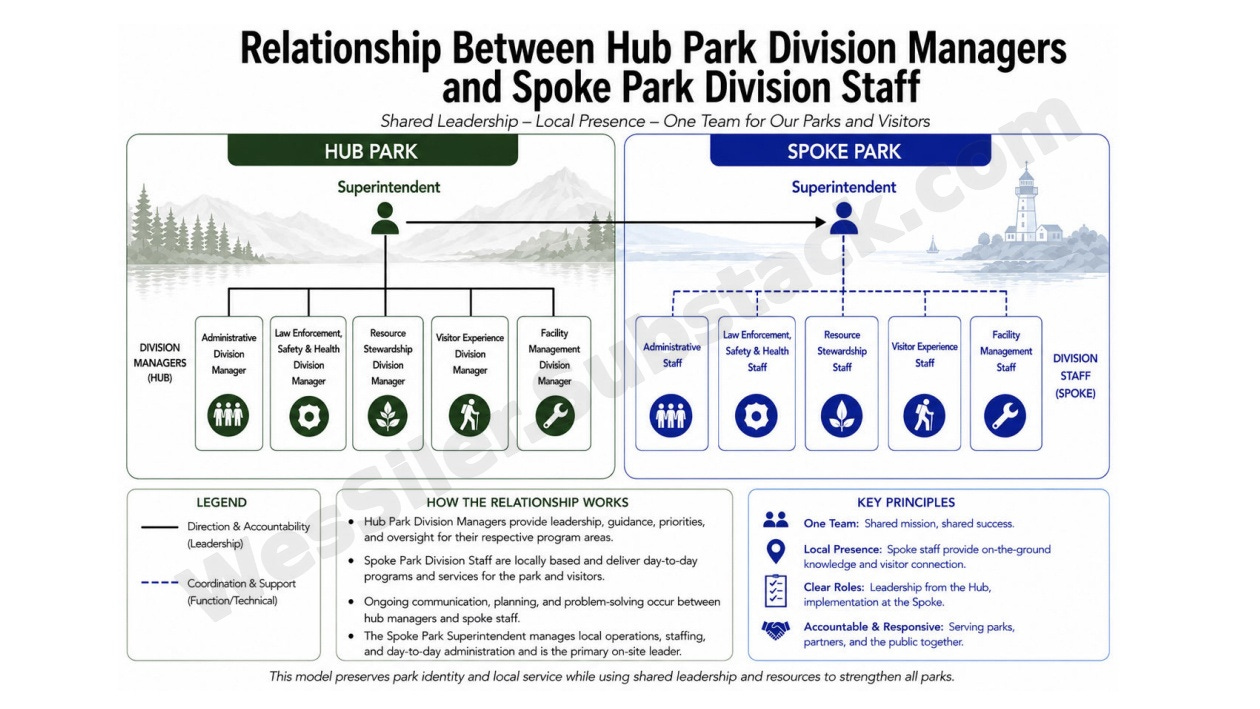
These are the fundamental bones of the plan, which will create tiers of superintendents, and shift all management decisions to political appointees.
If Burgum is to succeed at his goal of destroying the National Park Service, he must first centralize and politicize control of the parks and their employees. Seen here for the first time, this is his plan to do just that.
The first part of this agency reorganization is to eliminate the park service’s current regional management structure, and replace it with a new hub-and-spoke design in which some park superintendents themselves will be placed in charge of management across a group of “spoke” parks.
How does this work towards Burgum’s goal? Below the level of Director, NPS staff are career professionals, not political appointees. Not only is Burgum currently under a court order not to pursue any further RIFs, but these seven regional directors and their 1,100 management staff will have been working for NPS for decades, outlasting several administrations. They’re loyal to the park service’s mission of “preserving unimpaired the natural and cultural resources and values of the National Park System for the enjoyment, education, and inspiration of this and future generations.”
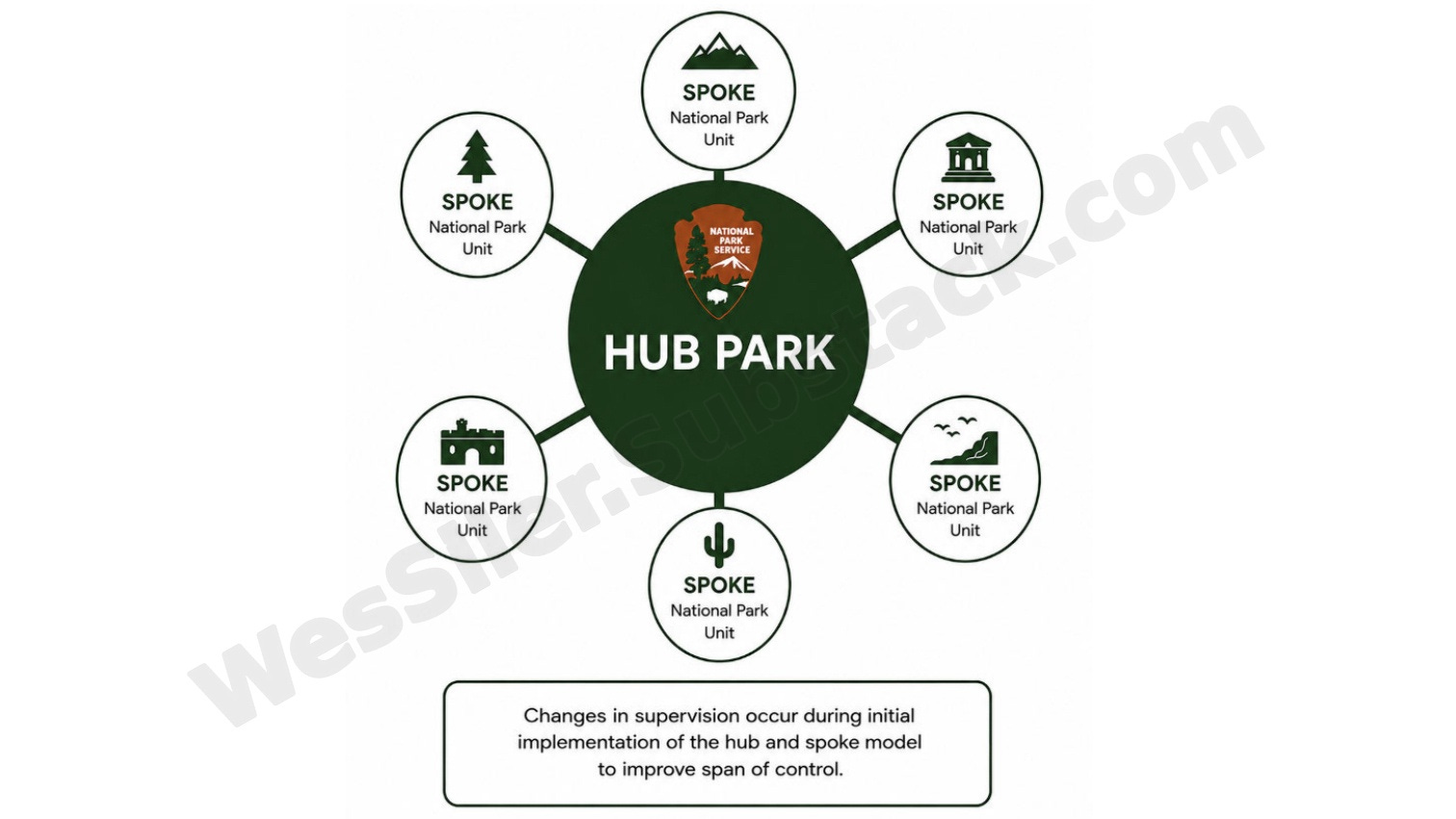
According to the Washington Sun, DOI used Claude AI tools to generate these snazzy graphics.
Under the current organizational structure, park superintendents (who serve as the executive managers of the parks they’re assigned to) are chosen by regional leadership, not DOI appointees. By eliminating regional offices, Burgum will also be able to eliminate regional directors and management staff, without directly firing them. The hope here is that will achieve targeted firings while avoiding judicial oversight, and in absence of an NPS Director, move the selection of park superintendents to Burgum himself.
In an unprecedented move, superintendents at these newly-designated “hub” parks will be given management authority over all the “spoke” parks under them. According to DOI’s plans, “hub” superintendents will become the “Direction & Accountability Leadership,” while “spoke” superintendents will only implement the policies of their new managers. “Hub” superintendents will have authority over all budgets, staffing, and management decisions at their “spoke” parks.
It remains unclear how NPS’ 433 units will be divided between “hubs” and “spokes.”
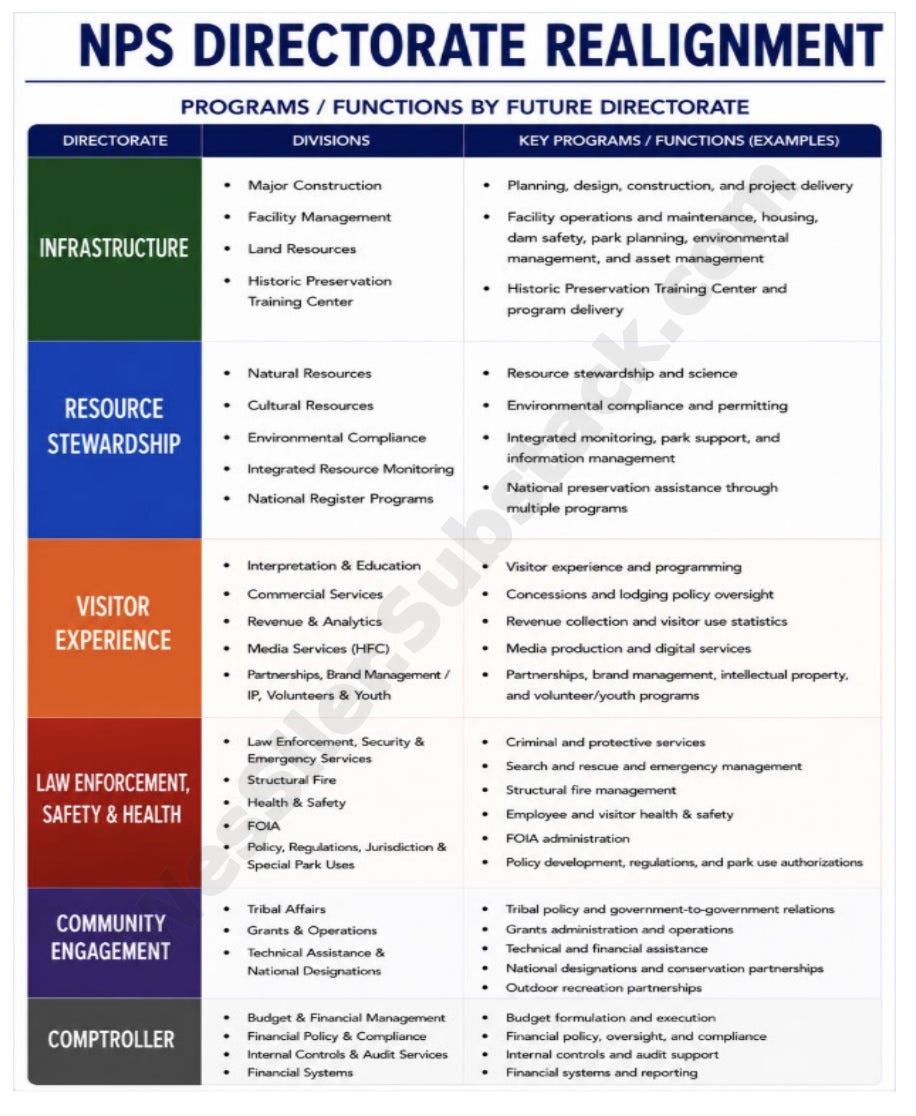
These are all the individual park functions that DOI plans to move under “hub” superintendent management. This is basically every park function. “Spoke” superintendents will be left with virtually no authority beyond implementation.
NPS employees I’ve spoken to explain that this approach will not just be incompatible with agency culture, but will impair the ability for parks to be managed as the dynamic, unique, natural places they inherently are.
For example, a major consideration in Glacier is managing the thousand-or-so grizzly bears that call the Crown of the Continent home, ensuring both the safety of the bears and the three million humans who visit that park each year. If management of Glacier is shifted to a politically-appointed superintendent who may or may not have experience with grizzlies, at a park which isn’t home to them, how will that impact daily in-the-moment decision making, or long-term budgeting and planning?
It seems almost comical that this reorganization plan claims this model is necessary due to “uneven staffing levels,” given that Burgum’s own orders are what have created that problem.
“I used to watch superhero movies and be amazed that the villain would so easily give away their plan,” says one NPS employee, who wishes to remain anonymous for fear of persecution. “If people knew what they were intending, wouldn’t they stop trusting them? Yet here we are almost a year and a half after Russell Vought specifically said he wanted to ‘put federal employees in trauma’ to get them to quit, and the NPS is still asking us to believe that a giant re-organization, that’s being pushed through right before the midterms, conducted in secret, and without any input from affected employees, is being done in good faith.”
Another key talking point in the plan is that “No reductions in force are anticipated as a result of this realignment.” But, the opening paragraph of the executive summary directly contradicts that by stating, “The realignment addresses these broader organizational challenges by reducing duplication.”
That is followed up later in the plan with “Uneven staffing, fragmented support structures, and duplicative work have limited consistent support across regions and headquarters.”
“Every single staffing decision pushed through by this administration has had the ultimate goal of pushing out federal employees,” continues that staffer. “They claim it’s for ‘efficiency’ but it just so happens to be coinciding with the plundering of our public lands for profit. The first step of selling off public lands is to get rid of the public employees who spend their careers protecting them. This re-organization reeks of corruption, privatization, and trauma all bunched together in a trench-coat, trying to pass as operations management.”
When will all this go down? The planning documents provide an implementation timeline of 30 days, following meetings with Congress, NPS leadership, and union representatives scheduled on or around September 9. But, NPS employees with knowledge of the plan explain to me that thinking has shifted since word of the reorganization began to leak in late August, leading to multiple press inquiries. That would have put the reorganization in sync with the beginning of the new fiscal year on October 1. But now, they’re worried that this leak may mean that the plan is proceeding on an unknown timeline, without any consultation with the NPS staff it will impact.
What will the National Park Service look like on the other side of this reorganization? Perhaps fittingly, it might be the world’s first national park that shows us. There, Superintendent Cam Sholly—a 30-year veteran of the agency—announced his retirement on September 11, shortly after news of the reorganization leaked. His departure date is scheduled for the end of this month, just before Burgum planned to implement the re-org, pre-leak.
If Sholly is replaced by a political appointee with little to no experience at NPS, it could be the beginning of a very dark era for our national parks, and the staff charged with preserving them for future generations. One in which Washington’s political whims take precedence over visitor safety, and where Burgum’s talk of “assets” could start to be attached to dollar signs.
On a personal note, today marks one year since Outside fired me for putting together stories like this one. Upgrading to a paid subscription supports my work.
On Public Lands, Could Chaos Be A Ladder?

News from just this week: The Fish and Wildlife Service issued a memo saying it’s ok to kill endangered species, so long as you say you didn’t mean it. Mike Lee is trying to apply the Congressional Review Act to the old management plan for Bears Ears, potentially breaking permitting across all national monuments and teeing up a fail-by-design assault on the Antiquities Act. And, of course, the Roadless Rule is moving closer to its inevitable repeal. That’s all terrible and unprecedented, but in this destruction I see something else: an opportunity to completely rethink how we protect, manage, and regulate America’s nature.
The Literacy Crisis Reaches Dog-Bear Science

“New analysis of more than 300 bear encounters suggests our canine companions often increase odds of conflict and rarely serve as early warning systems many recreationists assume,” reads a subhead in Mountain Journal. The thing is, that study reaches no such conclusion. But you have to read beyond the abstract to understand that.
To Save Ken Paxton’s Candidacy, Republicans Are Cancelling Big Bend National Park Border Construction

Fearing that Ken Paxton’s grossly unpopular campaign will combine with anti-Trump sentiment to flip Texas blue, Republicans have successfully convinced Customs and Border Patrol to massively alter plans for the portion of the border “wall” being constructed in Big Bend National Park. According to an insider with knowledge of the decision making process, no new infrastructure will be built following the path of the Rio Grande river, which forms the park’s border with Mexico.
This is so disturbing that I feel sick! It just blows me away how these hacks have done so much damage and are now putting the Parks in peril like nothing we have ever seen in our lifetimes. They have no respect for our love of National Parks which are so rich in history and have given us all so many great times and provided incredible environments to cherish forever.
Thanks for this excellent article. To counter these plans, I ask your readers to sign-up with the recently established National Parks Political Action Committee: www.parkspac.org