
Interior Orders Politicization Of Death, Injury Reporting In National Parks, Public Lands
Here’s leaked communications guidance DOI issued to all employees


“We used to be able to release specifics about serious accidents and incidents,” complains an employee of the National Park Service who has asked to remain anonymous for fear of retribution. “Now we can’t release any demographics or specifics, just say, ‘the NPS responded to a serious incident’ with no other details. Which basically makes everyone who has someone visiting the park thinking their loved one has died.”
New guidance issued early this year across Department of the Interior instructs federal employees to severely limit the amount of information they share following a fatality or serious injury on public lands, and redirects all fatality information through DOI’s central Office of Communications.
Under Secretary of the Interior Doug Burgum, the identities of political appointees serving in leadership at DOI remain secretive and fluid. It appears as if DOI OCO may currently be run by Jarrod Agen, who formerly ran communications for Mike Pence during the first Trump administration. Aggen’s LinkedIn lists his current employer as “Make America Energy Dominant Again!” And the cover photo on that profile shows a balding man in a cheap suit standing next to Burgum in the Oval Office, behind Trump.
By leaving the public in the dark about potentially dangerous conditions, this order risks visitor safety, and by removing all identifying information about victims, it threatens to create panic.
Combined with last April’s order from the interior secretary ordering that all trails, attractions and features in national parks must be made open except with his specific authorization to close them, this guidance creates a situation in which park staff no longer have say or control over visitor safety.
DOI manages the National Park Service, Bureau of Land Management, U.S. Fish and Wildlife Service, Bureau of Reclamation, and Bureau of Indian Affairs. Those agencies are responsible for about 20 percent of all land area in the United States, hundreds of millions of annual visitors, and spend annually $88.6 billion taxpayer dollars.
In order to keep the identity of the whistleblower confidential, I am going to reproduce the document in full by re-typing it, rather than sharing it in its original form. Feel free to blame any typos on me:
FINAL: for internal use only, not distribution.
This guidance does not supersede the department manual chapter reporting requirements.
INTERIOR CRISIS COMMUNICATIONS GUIDANCE
Fatalities and Serious Injuries on Interior Lands
PURPOSE
This guidance establishes Interior requirements for communications involving fatalities, serious injuries, or potential loss of life on Interior-managed lands or facilities. It applies to all Interior communications involving fatalities, suspected fatalities, serious injuries, or emotionally sensitive incidents.
This guidance provides clear direction on what communications personnel may and may not say
during these incidents to protect public safety, investigative integrity, operational security, and
the dignity of those involved.
Clear, disciplined language during fatality and serious injury incidents protects public safety,
preserves investigative integrity, respects affected individuals and families, and prevents
additional harm or risk.
2. APPLICABILITY
This guidance applies to:
• All Interior bureaus and offices
• All Interior employees who communicate with the public or media. All unit-level, regional, and bureau-level communications related to incidents involving fatalities, suspected fatalities, serious injuries, or life-threatening events on Interior lands or facilities.
This guidance applies regardless of incident cause, jurisdiction, or investigative authority.
3. CORE PRINCIPLES
• Life safety and investigative integrity come first
• Accuracy over speed
• Interior does not speculate
• Interior does not confirm medical or legal determinations
Communications must never interfere with law enforcement or death notifications
4. ABSOLUTE PROHIBITIONS
The following prohibitions apply to all public- facing communications, including press releases, interviews, phone calls, email responses, background conversations, on-camera remarks, social media posts, and real-time interactions with media or the public.
The following actions are not permitted:
4.1 Suicide Language
• Interior shall never confirm or state that an incident is a suicide.
• Interior shall never use the word “suicide” in public-facing communications.
• Interior shall never speculate on intent, cause, or manner of death.
Reason: Suicide determinations are medical and legal findings and must be communicated, if at all, by law enforcement or medical authorities, not Interior.
4.2 Death and Injury Confirmation
• Interior shall not confirm a death. Confirmation of death shall occur only through appropriate authorities following next of kin notification and Office of Communications (OCO) coordination.
• Interior shall not confirm the severity of injuries.
• Interior may state only that an individual was transported and the method of transport. No additional medical information may be released. All follow-up inquiries shall be referred to the receiving medical facility or appropriate medical authority.
Reason: Interior is not a medical examiner or coroner and does not make medical or legal
determinations.
4.3 Notification Protocols
• Interior shall never be the first to inform the public of a fatality or suspected suicide.
Interior shall never communicate information that could result in next-of-kin learning of a death through the media. Interior communications personnel shall not conduct next of kin notification unless explicitly authorized by statute, agreement or memoranda of understanding, in which case Interior law enforcement is the authorized notifying entity.
4.4 Independent Releases
No press release, media statement, or public facing communication regarding a fatality or serious injury may be issued without coordination with OCO.
This prohibition applies to any Interior office, bureau, or organizational component. No entity other than OCO is authorized to issue an independent release during these incidents.
4.5 Quotations
• No quotes from superintendents, park managers, or local leadership shall be used during
incidents involving fatalities or serious injuries.
• Leadership quotes may be considered later, with OCO coordination, when appropriate.
This prevents inadvertent speculation, premature attribution, or emotional statements that may
interfere with investigations or notifications.
4.6 Investigative Authority
• Interior shall not provide detailed incident narratives when it is not the lead investigative agency.
• Interior shall not characterize causes, responsibility, or contributing factors.
• This includes informal explanations, contextual framing, or narrative descriptions provided outside a formal release.
4.7 Media Referrals
• Interior shall not refer media to another lead agency without first notifying that agency.
• “Please contact [agency]” shall only be used after coordination. Coordination under this section requires advance notification and affirmative agreement by the receiving agency to accept media inquiries.
5. WHAT INTERIOR MAY CONFIRM
During the initial phase of an incident, Interior communications may confirm only the following, with OCO coordination:
• That an incident occurred
• The general location
• That Interior personnel or partners are responding
• That the incident remains under investigation
• That additional information will be shared when appropriate
If any element is not confirmed, do not include it.
6. STANDARD THREE-SENTENCE INCIDENT TEMPLATE
This template is the default during incidents involving fatalities or serious injuries. Interior is responding to an incident that occurred [general location] on [date]. Emergency responders are on scene, and the incident remains under investigation. No additional information is available at this time.
Notes:
• Do not add adjectives.
• Do not add injury details.
• Do not speculate.
• Do not expand unless OCO directs otherwise. OCO has longer templates for incidents upon coordination.
7. OPERATIONAL SECURITY AND INVESTIGATIONS
Interior communications shall:
• Avoid releasing information that could compromise investigations or responder safety.
• Defer to law enforcement and investigative authorities for determinations related to cause, intent, or responsibility.
State when appropriate: “For safety and security reasons, we do not discuss operational or investigative details.”
8. ROLE OF OCO
OCO Coordinates all Department-level messaging during fatality or serious injury incidents
• Provides approved language and templates to bureaus
• Advises on timing, scope, and escalation of communications
• Serves as the coordination point for national or sensitive media inquiries
• Is the sole authority for approving public- facing communications during fatality or serious incidents
Immediate OCO notification is required when:
• Media inquiry involves a fatality
• Incident occurs at a high-profile site or during high-profile, large visitation events
• Incident may draw national or large-scale social media attention
Serious incident that involves children, visitors, or employees
9. TRAINING AND ENFORCEMENT
All Interior personnel who may interact with media shall receive training on:
• This guidance
• Fatality and injury communications protocols
• Operational security considerations
Failure to follow this guidance may:
• Compromise investigations
• Harm families
Create legal and reputational risk for Interior
10. KEY TAKEAWAYS FOR COMMS STAFF
• You do not confirm deaths.
• You do not say suicide.
• You do not issue releases without OCO coordination.
• You do not quote superintendents.
• You do not speculate.
You do not refer media without coordination.
When in doubt, stop and coordinate with OCO.
11. LANGUAGE STANDARDS FOR FATALITY AND SERIOUS INJURY INCIDENTS
11.1 Required Language Standards
Interior communications shall:
• Use neutral, factual, and non-descriptive language
• Avoid emotionally charged or narrative framing
• Limit information to what is confirmed and releasable
• Focus on response actions and public safety priorities
Communications are intended to inform, not explain or characterize incidents.
11.2 Prohibited Language and Framing
The following are not permitted in Interior communications:
• Descriptions of methods, mechanisms, or circumstances of death or injury
• Statements implying intent, motive, or personal factors• Language that assigns blame or responsibility
• Graphic, vivid, or detailed descriptions
Speculative or explanatory framing
Interior shall never:
• Characterize the cause or manner of death
• Attribute intent or mental state
• Describe how an incident occurred in detail
Use euphemisms or alternate phrasing that implies suicide or intent
11.3 Approved Neutral Language That Will Not Harm an Investigation
When addressing sensitive incidents, Interior communications may use neutral phrasing such as:
• “An incident occurred”
• “Emergency responders are on scene”
• “The incident remains under investigation”
• “No additional information is available at this time”
Language should remain brief, factual, and limited to confirmed information.
11.4 Use of Support or Resource Information
Interior communications shall not proactively include crisis, support, or resource information
unless:
• Directed by OCO, or
• Coordinated with the lead investigative or response agency, or
Required due to broader public safety considerations
Such information shall not be added by default.
11.5 Responding to Questions About Cause or Intent
If asked by media to characterize cause, intent, or circumstances, Interior communications shall decline and restate investigative status.
Approved response framework:
“Interior does not characterize cause or intent. That determination is made by appropriate authorities, and the incident remains under investigation.”
No additional explanation should be provided.
11.6 Protection of Families and Notifications
Interior communications shall always assume that:
• Families may learn of incidents through public reporting but our standard is to allow local
law enforcement time to notify the family
Premature or detailed information can cause harm
Interior shall not release information that could result in next-of-kin learning of a death through the media or public statements.
11.7 Training Emphasis for Language Standards
Training for communications personnel shall reinforce that:
• Less information is often safer
• Neutral language is intentional, not evasive
• Silence or limited statements may be appropriate
Coordination with OCO is required when uncertainty exists
When in doubt, communications personnel shall pause and coordinate with OCO.
Leadership-Safe Bottom Line
• This is about public safety
• This is about investigative integrity
• This is about not causing harm
This is about staying in our lane
No ideology. No buzzwords. Just disciplined communications.
That’s a lot of very dry language and some seemingly rational explanations—who wouldn’t want to respect next of kin? So I asked my source at NPS for clarification.
“This is a totally insulting joke,” they told me. “Normally we can release very detailed information for preventative Search And Rescue purposes. Now, if someone died due to changing conditions, we can’t release anything about that and prevent other people from dying.”
This is exactly what just occurred in Grand Canyon National Park. When the body of a hiker was found dead on South Kaibab Trail on June 12. NPS was aware the cause of death was extreme heat, and wanted to warn other visitors that was proving deadly, but OCO sat on the news for seven days, and only released it after journalists started sniffing around. In the meantime, two more hikers died in the same place, for the same reason. Had NPS staff been enabled to warn them of the first death, they may have chosen not to hike that day, and they might still be alive.
We can see the effects of the order in incident reports published by NPS before and after it was issued.
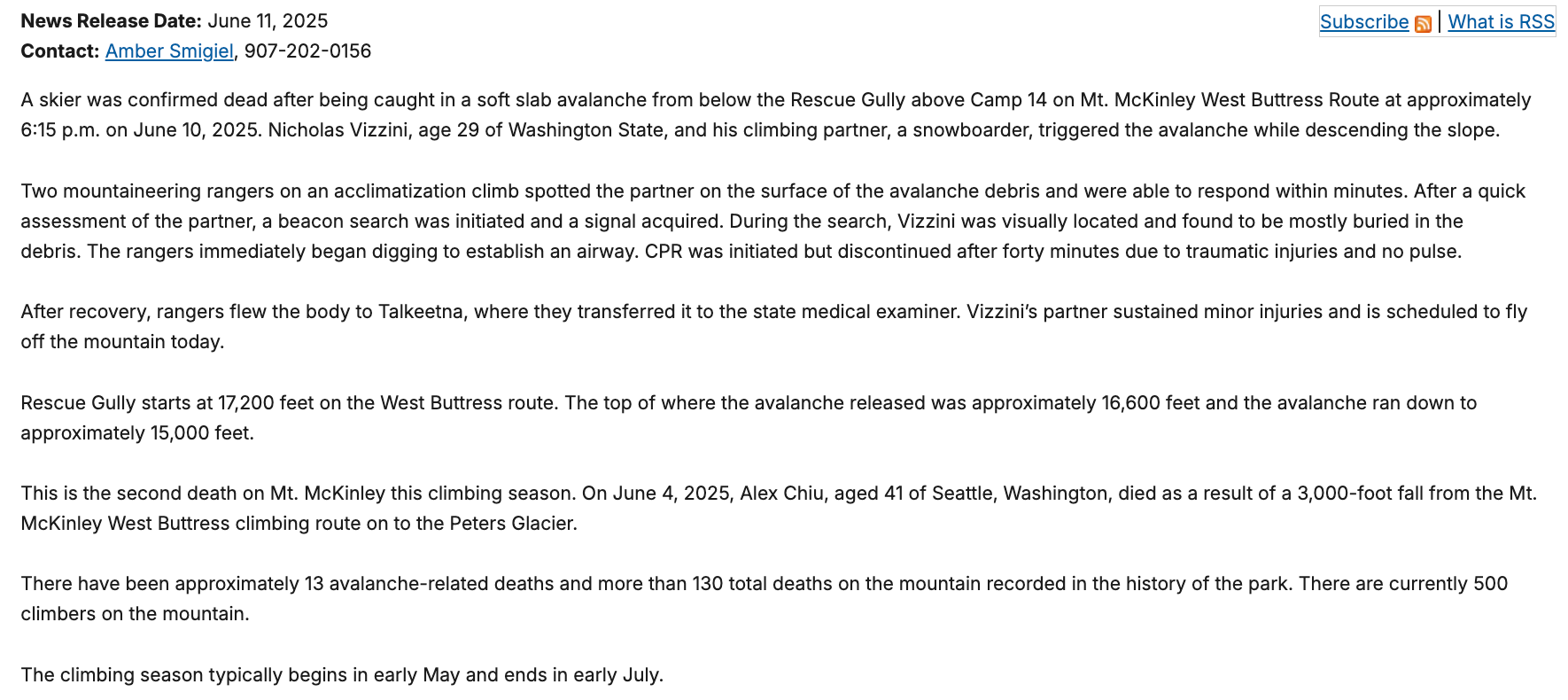
This one, from June 11, 2025 reports on a death that occurred just the previous day in Denali National Park. It includes details of the precise location and time of the death, its exact cause—an avalanche triggered by the skier’s partner—and the measures rangers took to try and rescue the victims. It also includes historic data on the risk inherent in recreating on the mountain.
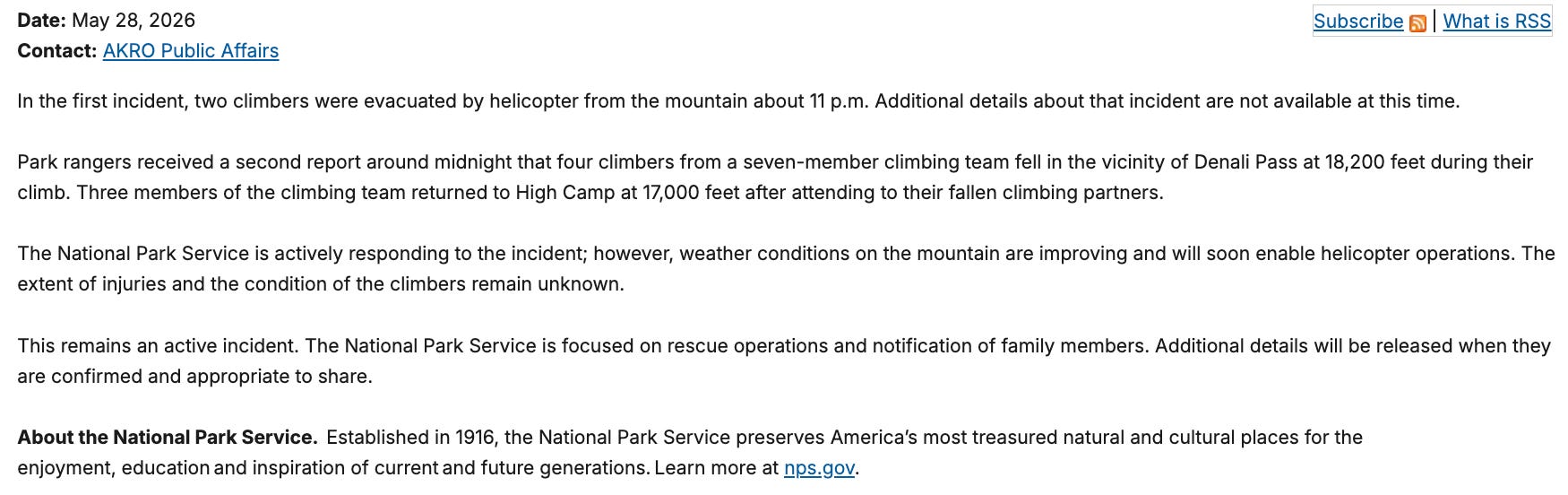
Compare that to this one published after the order was put in place, on May 28, 2026. It was also published the day following the incident it reports on, but lacks any details on the makeup of the party involved, their exact location or route of travel, the cause of the incident or the measures SAR workers took in its aftermath. “Weather conditions” of some unknown kind are mentioned, but no specificity is given.
In the first, we can see that other visitors recreating in the park were warned of avalanche danger at a given location and altitude, which could have been potentially life saving information. There’s also enough identifying details that a family waiting for loved ones at home could have decided whether or not there was cause to worry. Details of the response in the first incident would have been useful to the local community, family and friends, and any other potential stakeholders. All of that is missing from the second example.
In a political context, in which decisions and mistakes made by the administration are picked apart in the daily news, it seems obvious why DOI may want the ability to manipulate the timing and content included in any report of a visitor death in a high profile national park or other area of public land. But we are already seeing examples of how that manipulation of death and injury reporting is potentially contributing to reduced visitor safety, and more deaths.
DOI is killing national park visitors in order to keep news of deaths occurring in national parks quiet.
“The last paragraphs are so stupid,” says my source. “‘Stay in your lane’?? Woke ‘ideology’?? WTF are they talking about?”
Top photo: NPS
A journalist with more than two decades of experience working around the world, Wes Siler is here to cut through the outrage and disinformation to bring you the factual, insightful, actionable reporting you need to understand what’s going on. Upgrading to a paid subscription supports this reporting, and buys personal access to Wes, who will help you save money on gear, plan outdoor adventures, and prepare for real life, and who promises he’s less salty in real life than he sometimes comes across as on the Internet.
My thought as I read through the incredibly detailed, prescriptive language of the DoI guidance was that they really must expect the staff cuts; the "deferred maintenance"; the large, unregulated crowds to result in an increase in serious accidents and even deaths. And they want to protect themselves. And, of course, they're not interested in protecting the American public by hiring staff, maintaining the parks, reinstating reservations to control crowds, etc.
Having created and read a bunch of these types of documents, my guess is that whole framework is AI generated after some prompting, and those last lines — “LEADERSHIP-SAFE BOTTOM LINE…” — weren’t actually meant to be pasted as part of the memo, but rather are whatever model they are using’s way of summarizing the instructions it received to generate a generic sounding set of instructions.
A more generous — if you’re open to it — read would be not outright malevolence, but rather someone trying to put together comm standards quickly using AI without much thought into the prompting besides “don’t make it political.” The output then becomes super generic, “safe,” and ultimately unhelpful for any purpose besides providing cover — and with no one caring enough to read it or make it more human (and ultimately useful), it just becomes another piece of the bureaucratic morass.