
Bear Spray Is A Placebo
A hiker in Glacier National Park was just killed by disinformation. Here’s how to make sure the same thing doesn’t happen to you.

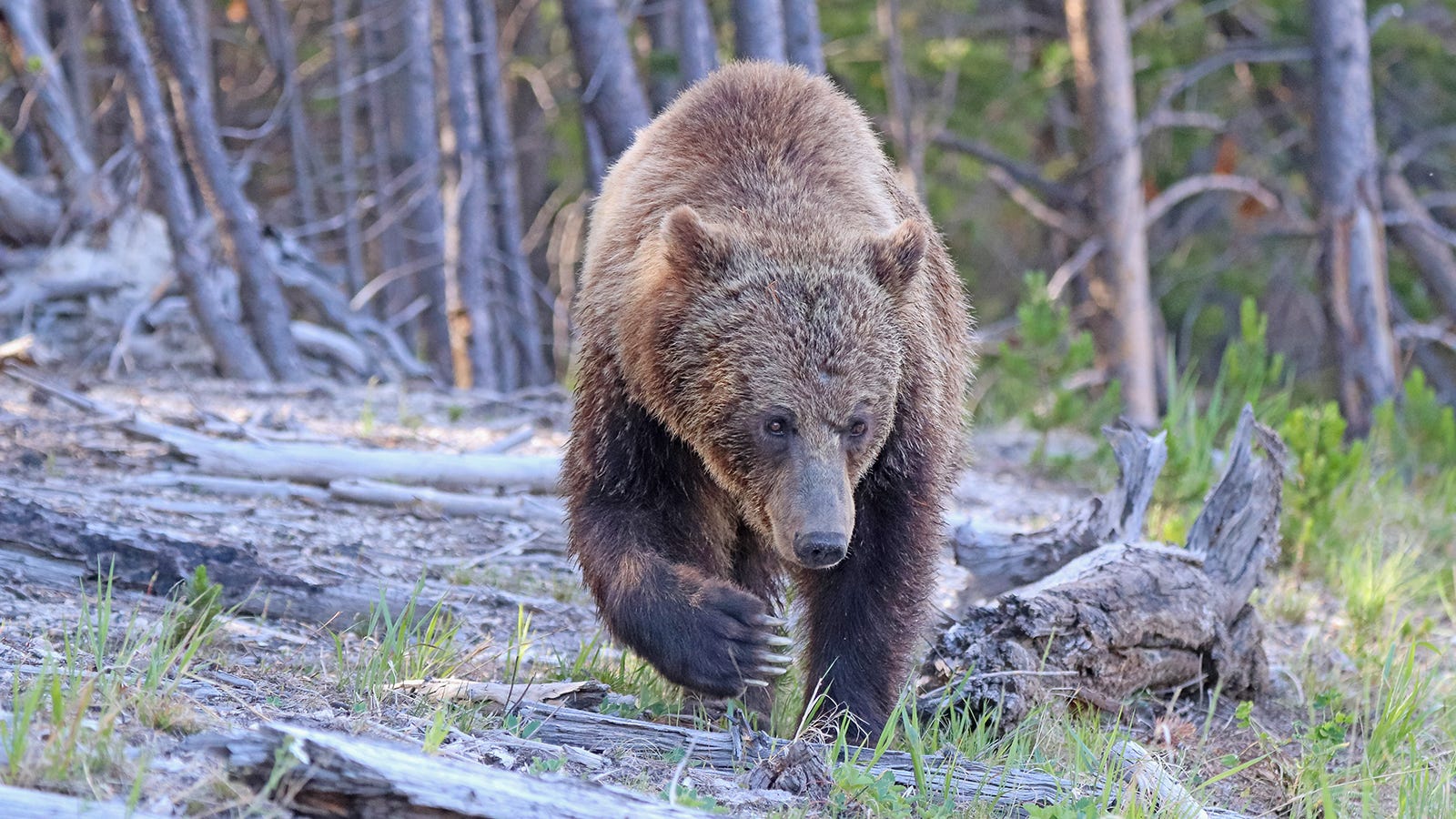
On Wednesday, search and rescue crews in Glacier National Park located the body of a missing hiker. A statement reads, “His injuries are consistent with those sustained by a bear encounter.” Rumor has it that an empty can of bear spray was found alongside the body. Given the overwhelming presence of the message that bear spray is more effective than firearms, I think it’s reasonable to draw the conclusion that it wasn’t a grizzly bear that killed the man, it was disinformation.
If there’s one thing that sparks more controversy than guns in this country, it’s our ability to exist alongside large predators. And because that conversation often overlaps with the one around America’s toxic gun culture, and with our often clashing urban-rural, liberal-conservative cultural divides, it’s devolved into an absolute shit show. A shit show that precludes any chance of effective information reaching the people who need it.
As is anyone else who participates in the discussion around coexisting with grizzly bears, I am biased. As a mildly autistic person with an overdeveloped sense of justice, a special interest in bears, and who is quixotically pursuing the cause of journalism even as that profession is being destroyed by fascism, my bias is towards fact. In this article I’m going to do my best job as a journalist to present facts, and encourage you to use those facts to make smarter decisions about your own safety.
Fact Number One: Bears Are A New Problem
The population of grizzly bears in the Northern Rockies fell under 1,000 total bears by the late 1960s, and recovery efforts began in 1975, when the species was listed as threatened under the Endangered Species Act.
A large, slow-breeding omnivore prone to conflict with humans, grizzly bear populations expand gradually. Today, that population has roughly doubled from when the bears were listed.
The density of brown bear populations is determined by food sources. And with those remaining largely stagnant (or even becoming more sparse due to factors like climate change), young bears are forced to disperse to find territories not already claimed by mature adults.
This means that as bear populations grow, the bears are moving into places they haven’t lived for at least five or six decades, if not a century or more. And in that same time, the region’s population of humans has boomed. Towns and highways have been constructed in the places grizzlies used to live, while industrial farming and livestock grazing have moved not just into former grizzly habitat, but into the very mountain ranges that were once bastions for wild animals.
All brown bears everywhere in the world are the same species. But, populations elsewhere do not necessarily give us analogous practices we can apply to the Northern Rockies. Brown bear behavior and size vary heavily by ecosystem.
In coastal Alaska, for example, the Peninsular Brown Bear grows to roughly double the size of interior grizzly thanks to an ample supply of salmon. The bear I got a one-shot kill on there a couple years back stood nearly 10-feet tall. Those bears live in much denser populations in areas with few humans. They’ll run at the sight or smell of a human.
In eastern Europe, brown bears live in much closer contact with humans than they do even here in Montana. While staggering back to the hotel one night with a friend in the Romanian secret police, we saw one in an alleyway in downtown Brașov, which counts over 300,000 humans in its metropolitan area. It didn’t mind us watching it chow down on garbage from 20 yards away.
All that’s to say two things: 1) People living in or visiting the Northern Rockies and adjoining plains have not yet developed a broad cultural understanding of how to live alongside the grizzly. And 2) Information gathered elsewhere does not always apply well to our bears.
Fact Two: Bear Spray Is Not Effective In A Bear Attack
The only study ever conducted into bear spray’s efficacy found that, in an actual bear attack, bear spray was only totally effective one-third of the time.
I’ll wait while you wipe off the coffee you just spat on your computer screen.
The reason why you find that number so surprising is that it runs completely counter to the omnipresent propaganda spread by people that think you’re too stupid to handle the truth.
The common claim about bear spray is that it’s more effective than a firearm. The trouble is, that claim is in no way connected to reality.
I explored this in detail in Outside, before that publication fired me for writing articles like that. The origin story for it is that the PR department at BYU was desperate for a headline, so convinced a journalist at The New York Times who really should have known better to conflate the results of two different studies in order to reach a conclusion not supported by the science.
Source: the scientist who conducted those two studies. I called Tom Smith up at his home in Alaska, and he told me, “The appearance that bear spray outperforms firearms was not the focus of our work.”
The quick explanation there is that Smith conducted two different studies (among many others). The one about bear spray was intended to give federal conservation agencies the data they needed to give their workers bear spray for use in field work. Smith told me that most of the incidents he studied were, “largely intentional hazings, not surprise-encounter-type situations.”
The study on firearms that’s so often compared set out with an entirely different purpose and methodology. It was designed not to produce a conclusion on whether or not firearms are effective at stopping bear attacks, but rather to study the reasons why firearms sometimes fail to stop a bear. As such, Smith purposely selected incidents in which firearms failed, while excluding data sets that demonstrated their success.
No study has ever set out to compare the success rate of firearms to the success rate of bear spray. Anyone who ever suggests otherwise is lying to you.
And the entire problem with that conversation isn’t the false conclusion that’s so widely spread, it’s the binary framing of firearm vs spray, when a much more effective conversation would simply be built around preventing a bear from attacking you in the first place.
Fact Three: Avoiding A Bear Attack Is A Way Better Idea Than Trying To Stop One
In all of this, I’m constantly amazed that the conversation is so focussed around a false claim about bear spray’s efficacy rather than simply equipping people with the knowledge necessary to avoid a bear attack in the first place.
I live in Bozeman and regularly recreate across the Greater Yellowstone Ecosystem, our family owns a second home near Glacier National Park at which grizzlies are omnipresent, and I spend virtually all of every September, October, and November sneaking around grizzly habitat in the dark hoping to ambush a deer or elk. How do I stay safe? Knowledge.
According to Smith, the world’s foremost expert on human-bear conflict, simply going outdoors with another adult, and remaining close together, may be the simplest, most effective bear avoidance technique we have.
“To the best of my knowledge, I have not seen an instance where two or more persons have remained grouped, whether standing their ground or backing from a bear, that the bear made contact,” he told me.
Elsewhere in his research we can see that you’re twice as likely to be attacked by a bear in poor visibility terrain as you are when you can see a good distance. And that humans have a 90 percent success rate at terminating in-progress maulings by physically intervening, while those rescuers only have a 10 percent chance of being mauled themselves.
Put all that together—travel in groups and remain tight together, avoid areas of dense brush or tree growth when in bear habitat, help a buddy if they do get attacked—and you have the simple, effective, easily communicated information you need to actually stay safe in bear country.
It blows my mind that propaganda about bear spray is pushed at the expense of genuinely effective fact. I guess it’s just harder to package a few easy pieces of advice into a $40 can than it is some 2 percent capsaicin.
Top photo: NPS
A journalist with more than two decades of experience working around the world, Wes Siler is here to cut through the outrage and disinformation to bring you the factual, insightful, actionable reporting you need to understand what’s going on. Upgrading to a paid subscription supports this reporting, and buys personal access to Wes, who will help you save money on gear, plan outdoor adventures, and prepare for real life, and who promises he’s less salty in real life than he sometimes comes across as on the Internet.
What Happens When You Bear Spray A Human

Bear spray is in the news. Investigators analyzing videos of the deadly January 6 coup attempt have turned up evidence that U.S. Capitol Police officer Brian Sicknick was sprayed with a can of Frontiersman Bear Attack Deterrent. If it can be demonstrated that the spray caused Sicknick’s blood clot and stroke,
Let’s Talk About Handguns

Sorry for the month without newsletter content. There was a power outage at the cabin, then that whole coup attempt thing was happening just as Virginia and I got back home. My productivity in January amounted to very little, and I’ve been hustling to get back up to speed since. I’m going to try to crank out a few of these newsletters over the next week or so, to make up for lost time.
The Difference Between Conservation And Preservation

One of the most surprising things about animal conservation is how few people understand how it works. As we enter a time in which one side of the political spectrum is attempting to realize mass sell-offs of public lands—the places where wildlife lives—while the other is challenging the foundational tenants of conservation with anti-hunting ballot measures, it seems like a simple, clear explanation has become necessary. Here’s my attempt to create just that.
What I Learned About Guns From A Man Who Kills Brown Bears For A Living

A year-and-a-half ago Virginia and I went on an Alaska Peninsula brown bear hunt with an outfitter who calls himself “The Grizzinator.” Greg’s outfitted brown bear hunts for over 30 years, and has likely shot, or participated in the deaths of more of the big bears than anyone else out there. So aside from proving a great opportunity to spend a couple of weeks listening to Gregorian chants, it was also a fascinating chance to learn about the practical application of firearms in challenging environments and potentially deadly circumstances.
You're totally right and thanks for putting people (including myself) in their place again.
The guy who got killed in Glacier was by himself, was in a densely forested area, and was there at dusk. Three things you really, really, really shouldn't combine in Glacier, especially in the spring. Bear spray clearly didn't save him under those circumstances, nor would it have anyone.
Preventing a bad situation is always better than having to deal with a bad situation, so I agree that trying to avoid encounters in the first place should by anyone's first priority. Still, I'm personally going to continue carrying my bear spray in parks like Yellowstone, Grand Teton, and Glacier. I'd still take a 33% chance of stopping an aggressive grizzly over a 0% chance without any deterrent.
But yeah, just completely relying on bear spray alone is absolutely insufficient.
So use the buddy system with bears, use the bear spray on men. Got it.👍